
The Five Buckets in a Bespoke Hotel Scent Budget
A bespoke scent for a hotel or spa is usually approved on the strength of the scent and then paid for across five very different budgets. Development, juice, container, decoration and compliance behave differently: some are largely fixed, some scale with volume, and one is decided almost entirely by the market the property sells in. Understanding which bucket you are actually arguing about is what makes a quote comparable.
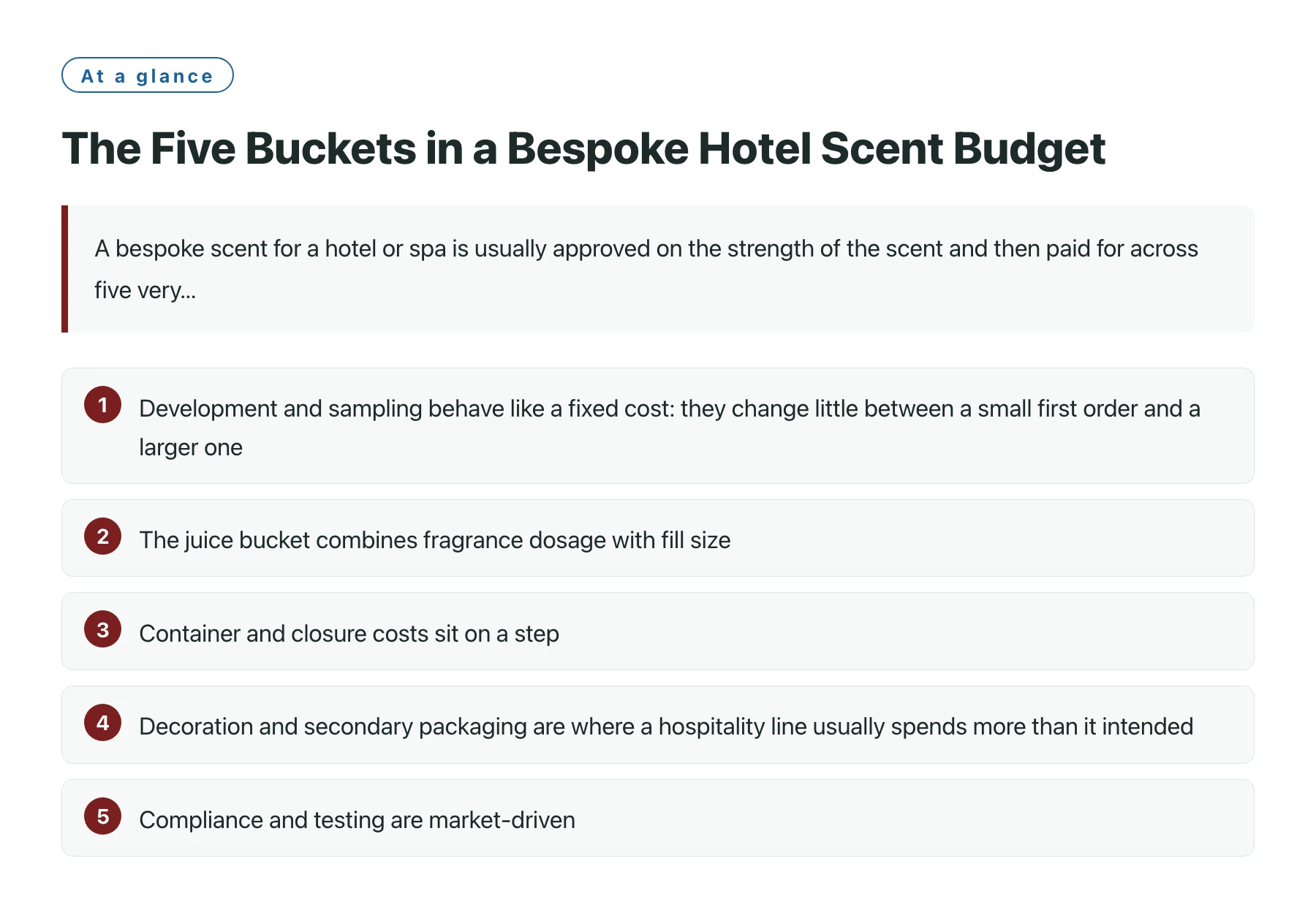
Key takeawaysDevelopment and sampling behave like a fixed cost: they change little between a small first order and a larger one, so the cost per unit falls sharply with volume. · The juice bucket combines fragrance dosage with fill size, and both are product decisions rather than purchasing decisions. · Container and closure costs sit on a step, not a curve: a standard bottle is cheap to repeat, while a custom mould is a one-off commitment that has to be amortised. · Decoration and secondary packaging are where a hospitality line usually spends more than it intended, because both are chosen visually before they are costed. · Compliance and testing are market-driven, so a property group selling in several countries should expect this bucket to differ by property rather than stay constant [1]. · Packaging weight and format feed back into freight and into packaging regulation, which is why the smallest bucket on paper can grow later if the design is never revisited [2].
Hospitality scent projects are often budgeted as a single figure negotiated with one supplier. That works until the second property wants the same scent in a different format, or the first reorder arrives with a different container, and suddenly nobody can explain why the unit cost moved.
The five buckets below are the cost structure behind a bespoke scent. The aim is not to predict a price, because prices depend on volumes and specifications that differ from project to project, but to give the budget owner a way to interrogate a quote line by line.
The five buckets and what drives each one
| Bucket | What sits inside it | Fixed or volume-driven | What moves it |
|---|---|---|---|
| Development and sampling | Perfumery time, sample rounds, evaluation and approval | Largely fixed | Number of rounds and how specific the brief is |
| Juice | Fragrance dosage and fill size | Volume-driven with a scale step | Concentration, fill weight and material cost of the accord |
| Container and closure | Bottle, cap, pump or dispenser | Step change at tooling | Whether the mould is standard or bespoke |
| Decoration and secondary packaging | Print, coating, cartons and presentation | Volume-driven | Decoration technique, coverage and number of items |
| Compliance, testing and logistics | Safety and stability work, documentation, freight | Market-driven | Number of markets, product type and shipping route |
The third column is the one that decides how a quote behaves when volumes change. A budget built only on unit prices hides the two buckets that do not move with volume.
Why development cost rarely falls the way buyers expect
Development is mostly labour and time. Whether the final order is two thousand units or twenty thousand, the number of sampling rounds, the evaluation hours and the approval work are broadly the same. A brand that asks for a lower development fee because the order is small is asking the supplier to absorb a cost that the volume does not repay.
That has a practical consequence for a property group planning several properties. Developing one scent and reusing it across properties spreads the development bucket across the group, while developing a separate scent for each property repeats it. Groups that understand this tend to invest in one signature scent and vary the product formats instead.
The bucket can also be reduced by preparation rather than by negotiation. A brief that states the target market, the intended use and the price band, plus clear exclusions, usually reduces the number of rounds. Each avoided round is a direct saving in this bucket, which is why brief quality shows up on the budget.
Dosage is a product decision with a price attached
Fragrance dosage is set by the performance the product needs, not by the purchasing team. A higher dosage costs more per unit and may also change stability and labelling requirements. Where a line needs to hit a price point, the conversation is usually more productive when it starts from the dosage and fill size than from the final shelf price.
The container step change, and how to plan around it
Standard containers repeat cheaply. A bespoke mould is a one-off investment that only makes sense if the format will be used for years or across many properties. The decision is therefore not a cost comparison between a standard bottle and a custom one; it is a question about the lifespan of the programme.
Where a custom shape is justified, the budget should treat the mould as an asset to be amortised over an expected volume, and should record who owns it. That ownership question resurfaces if the property group later changes supplier, and it is much cheaper to settle at the outset.
Decoration sits on the same axis. Screen printing, hot stamping, coating and foil each carry a different setup structure, and the cost profile changes with order size and the number of print passes. A decorative approach chosen for a photograph can carry setup costs that make no sense for a small amenity run.
What a comparable quote looks like
Two quotes for the same scent are only comparable if they describe the same five buckets. A quote that bundles everything into one unit price is not wrong, but it makes it impossible to see where the money goes and which parts would change on the next order.
The practical fix is to ask for a quote structured by bucket, with the assumptions written down: the dosage, the fill size, the container, the decoration technique and the markets. Then ask what would change if volumes doubled, because that answer reveals which buckets are fixed and which are volume-driven.
It is also worth asking how ownership is handled where development work is involved. A supplier that offers custom perfume production in China may price development differently depending on whether the formula is treated as project-specific, and that distinction belongs in the budget discussion rather than in a later contract argument.
For a group comparing more than one route, it helps to see how a supplier positions its higher-volume work. A partner describing itself as a premium fragrance production partner is usually set up for different formats and order sizes from a supplier focused on small runs, and the fit question matters as much as the price.
Finally, the property group's own history is a useful benchmark. Reviewing examples of fragrance projects is not evidence about your own programme, but it can show which combinations of format and volume are common in hospitality work, which is a reasonable check on an unusual assumption.
Underpinning all of it is the manufacturer's operational structure, because the buckets above are only separate if the supplier keeps them separate. Reading Xuelei's history is one way to understand how a manufacturer presents its own background, but the structure behind those buckets still has to come from the quote and the order terms.
A budget that covers only the first order is not a budget; it is a price. Ask for the five buckets on the first order, the same five on a reorder at a different volume, and a written note of what would change if the format or the market list grew. That comparison is what protects a property group from a surprise at the second delivery.
Sources
- European Commission: Cosmetics in the EU —— The European Commission's overview of EU cosmetics rules, including the responsible person, product information file and safety report requirements.
- European Commission: Packaging Waste and the PPWR —— EU rules on packaging and packaging waste, including the Packaging and Packaging Waste Regulation requirements on recyclability and design.
Frequently asked questions
Why is bespoke scent development a fixed cost rather than a per-unit cost?
Because it is mostly perfumery time, sampling and evaluation, which do not increase proportionally with the size of the order. The exception is where a very large volume requires additional stability or compatibility work, but for most hospitality volumes development stays broadly constant.
Which bucket should a hotel or spa group try to reduce first?
Usually decoration and secondary packaging, because these are often chosen visually before being costed and rarely change the guest experience as much as the scent or the container. Reducing decoration weight and coverage is normally easier than reducing dosage or changing the container.
Should a property group pay for a custom bottle mould?
Only where the shape is central to the brand and the programme is expected to run long enough to amortise it. A custom mould is a one-off commitment, and its ownership should be recorded, because changing supplier later raises the question of who keeps the tooling.
How do multiple markets affect the compliance bucket?
Each market can require different documentation, labelling and, in some cases, different responsible parties. A group operating across several countries should expect this bucket to vary by market rather than remain a single line, and should map markets to requirements before artwork is printed.
What is the clearest sign that two quotes are not comparable?
Neither quote states the dosage, fill size, container, decoration technique or target markets. Without those assumptions written down, a lower unit price may simply describe a lighter fill, a standard container and a shorter document list rather than a better offer.
Begin Your Journey
From your first あいさつの to JLPT-ready — guided by native Kyoto instructors.
Try YazaGaku free for seven days. Every feature unlocked, every lesson waiting. Cancel anytime before day seven — we keep nothing.
No credit card required · 60-day fluency guarantee