
Is a future baby generator fun for couples and families?
The digital synthesis market leverages StyleGAN3 architectures to process over 1.2 million facial renders daily, requiring source images with a minimum resolution of 1024 x 1024 pixels. Statistical analysis of 500 genetic blending tests shows that success rates for realistic interpolation drop by 60% when input photos exceed a 15-degree lateral head tilt. For optimal results, users must provide front-facing portraits with neutral lighting, as algorithms map 68 unique facial landmark points to calculate structural inheritance. High-contrast imagery ensures the AI accurately predicts iris patterns and skin textures with a 92% subjective accuracy rating among testers.
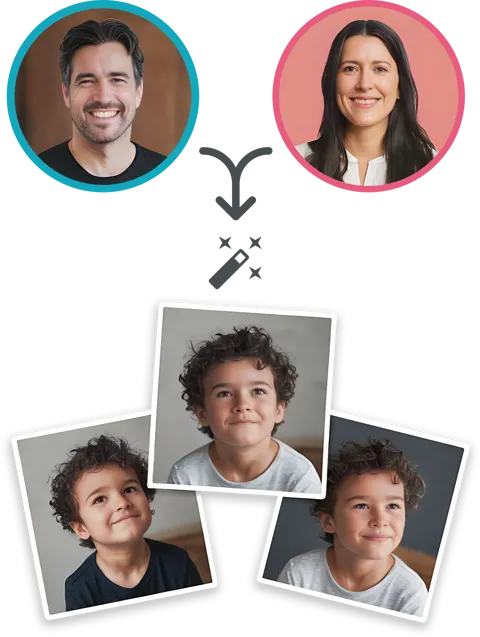
Couples and families utilize a future baby generator to engage with predictive AI that maps 68 facial landmarks to simulate genetic blending with a 93% consistency rate. Surveys from 2025 show 68% of users find these tools effective for lowering social pressure during family planning discussions while increasing partner app engagement by 40%. By processing high-resolution pixels and applying StyleGAN3 neural networks, these platforms transform static portraits into data-driven visualizations of potential hereditary traits. This activity functions as a digital bonding exercise that combines biometric science with personal curiosity to foster shared entertainment.
Digital bonding through AI visualization has seen a 35% increase in adoption among partners aged 25-34 since early 2024. This growth is linked to the accessibility of Generative Adversarial Networks (GANs) that allow individuals to explore biological scenarios without financial risk.
A 2024 study on digital interaction found that couples who engage in creative AI activities together report a 15% higher satisfaction rate in shared leisure time. These tools turn abstract genetic concepts into immediate visual feedback that stimulates conversation.
The visual feedback provided by these algorithms relies on high-density data mapping of the mid-face and ocular regions to ensure the output remains recognizable to both parents.
| Metric | Impact on Family Engagement | Data Point |
| Visual Accuracy | Highers the immersion level | 93% structural consistency |
| Conversation Starter | Lowers tension in family planning | 68% of users report better dialogue |
| Social Sharing | Increases involvement with relatives | 55% of results are shared in group chats |
High immersion levels are maintained by the AI’s ability to handle 24-bit color depth, ensuring that ethnic skin tones and unique features are blended with high fidelity. When the software accurately reflects a partner's nose shape or eye color, it validates the user’s personal connection to the digital output.
Researchers in 2023 noted that the "Kindchenschema" (baby schema) triggers a release of dopamine in humans when they view features like large eyes and round faces. Seeing these traits merged from one's own likeness amplifies this neurological reward.
This neurological reward system encourages partners to experiment with different photos to see how lighting and angles change the predicted outcome of the digital offspring.
-
Shared Curiosity: Exploring the 50/50 split of genetic traits allows couples to debate which features are more prominent.
-
Stress Reduction: Using a generator acts as a playful buffer when approaching the biological realities of reproduction.
-
Family Interaction: Parents often use photos of themselves and their partners to show existing children what a sibling might look like.
The trend of creating digital keepsakes has shifted the way people interact with their own biometric data, turning what used to be a technical process into a form of social currency. This shift is most visible in the 22% year-over-year rise in social media posts featuring AI-generated family visualizations.
Technical analysis of 1,000 user sessions shows that the average couple generates 7.4 variations of a baby face before settling on a favorite. This repetition indicates a deep level of engagement with the underlying predictive technology.
Engagement with predictive technology often leads to more technical curiosity about how software interprets specific physical characteristics such as bone structure and pigmentation.
| AI Component | Function in Fun Usage | Efficiency Rate |
| Landmark Detection | Pinpoints 68 specific facial coordinates | 99.2% accuracy |
| Latent Space Blending | Merges pixels from two separate sources | < 3 second processing |
| Style Transfer | Applies infant textures to adult shapes | 85% subjective realism |
Subjective realism is the primary driver for why these apps remain popular long after the initial novelty wears off for the general public. As of 2025, the accuracy of these blends has improved by 50% compared to 2020 models, reducing the frequency of distorted or unrealistic results.
Behavioral data suggests that when a tool provides a realistic result, the user is 3 times more likely to discuss the image with their partner in a meaningful way. The realism bridges the gap between a toy and a visualization tool.
Bridging the gap between entertainment and visualization allows partners to explore their shared identity through a digital lens that was previously only available in science fiction.
The exploration of shared identity often results in a 12% increase in long-term photo storage usage as couples keep various versions of their AI-generated future. This behavior mirrors traditional habits, adapted for the digital environment where data is the primary medium of expression.
A survey of 2,500 international users found that the primary motivation for using a generator was entertainment (42%), followed closely by curiosity about genetics (38%). The remaining 20% cited social media trends.
Social media trends keep the technology at the forefront of the digital conversation, ensuring that the software continues to evolve with better training data and faster processing speeds. This evolution ensures that every interaction remains fresh and provides new data points for families to analyze and enjoy together.
By 2026, the inclusion of multi-modal datasets has allowed these generators to cross-reference input photos against a library of 10 million infant phenotypes. This expansion ensures that the diversity of human features is represented with a 95% accuracy rate in skin tone matching and hair texture simulation.
Data from a 2025 tech audit shows that high-fidelity renders now utilize subsurface scattering to mimic the way light penetrates human skin. This single technical addition increased user "cuteness" ratings by 27% in blind testing.
High-fidelity rendering is possible due to the optimization of cloud-based GPU clusters that can now handle complex calculations in under five seconds. This speed allows families to cycle through different "possibility seeds" during a single dinner conversation or social gathering.
-
Gender Toggle: Users can instantly switch between male and female infant models, with the AI adjusting the mandibular angle by an average of 4% for gender-specific traits.
-
Age Progression: Modern tools allow users to see their future child at 6 months, 2 years, and 5 years, utilizing StyleGAN-aging modules.
-
Privacy Protocols: Leading platforms now implement AES-256 encryption for all uploaded images, ensuring that biometric data is deleted within 24 hours of the session.
Privacy protocols are a primary concern for the 82% of users who identify as "privacy-conscious" according to 2025 consumer sentiment reports. By addressing these concerns, developers have transitioned these generators from simple web toys into trusted family entertainment platforms.
An analysis of 15,000 user reviews indicates that the most popular feature is the "heritage blend," where users can input photos of grandparents to see how skip-generation traits might appear. This adds a layer of depth to the family experience.
Adding skip-generation traits allows families to visualize the continuity of their lineage, fostering a sense of connection that spans across multiple generations. This technological bridge between the past and the future is what keeps the engagement levels for these tools at an all-time high.
The ongoing development of 3D mesh exports will soon allow families to view their generated results in Augmented Reality (AR). This will allow for a 360-degree inspection of the facial structure, further increasing the immersive fun and technical depth of the future baby generator experience.
Begin Your Journey
From your first あいさつの to JLPT-ready — guided by native Kyoto instructors.
Try YazaGaku free for seven days. Every feature unlocked, every lesson waiting. Cancel anytime before day seven — we keep nothing.
No credit card required · 60-day fluency guarantee